
Clock In Class — notes from the floor
The number on your payslip is the best-case number.
It's what you earn per hour if the job takes exactly the hours it pays for, costs you nothing to get to, and never reaches into the rest of your week. I don't know a single floor where that's true.
On my floor you can't book an appointment, plan a school run or promise anyone a weekend, because the pattern can change on you. Twelve-hour days get banked as holiday you take later, usually when they need you somewhere else anyway. I cycle in, so my commute costs me time, not fuel. Most people aren't that lucky. None of that shows up on the payslip, and all of it is a cost.
Here's the short answer, in case you're on a break: your real hourly rate is what you take home after the cost of getting to work, divided by every hour the job takes from you, paid or not. You can work it out in five minutes. Nobody's going to do it for you.
One note first. Rules about unpaid time differ from country to country. This is maths, not legal advice.
Technical Sovereignty: The Five-Minute Sum
Grab a pen. You need five numbers for a normal shift.
- Pay for one shift. Use before tax or after, but be consistent.
- What it costs you to get there and do the job. Fuel, fares, parking, boots, gloves, uniform. Divide anything bought occasionally down to a per-shift figure.
- Paid hours. The hours on your payslip.
- Unpaid time. The minutes nobody pays: handover, walking in from the gate, changing, waiting for the line to be signed off, mandatory briefings.
- Commute. Round trip, in hours.
Then do this:
(Pay − costs) ÷ (paid hours + unpaid hours + commute hours) = your real hourly rate.
A worked example
Say you're paid $20 an hour for an eight-hour shift. That's $160.
Getting there and kit cost you $8 a shift. That leaves $152.
The job takes eight paid hours, half an hour of unpaid handover and walking in, and an hour on the road. That's 9.5 hours.
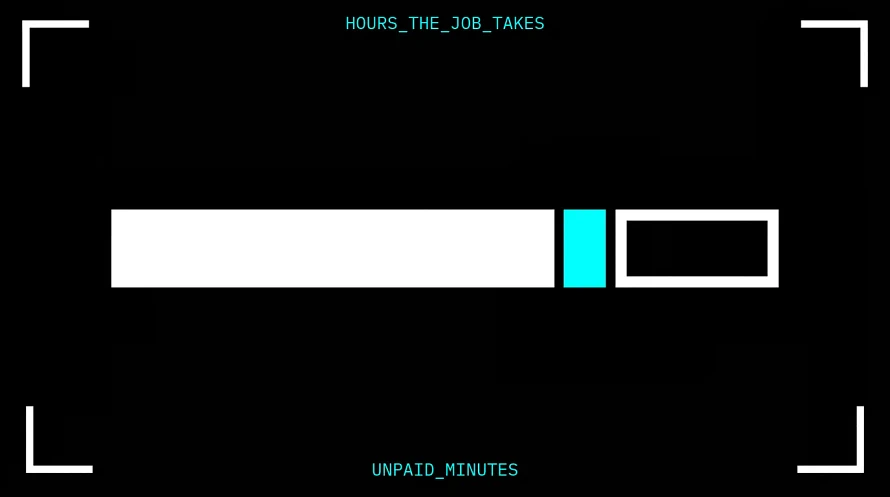
$152 ÷ 9.5 = $16.00 an hour.
Twenty on the payslip. Sixteen in real life. That's a 20 percent pay cut nobody announced.
Now try a twelve-hour day with the same costs and the same unpaid time. Pay is $240. Take off the $8, you have $232. The job takes 12 + 0.5 + 1 = 13.5 hours. $232 ÷ 13.5 = $17.19.
Long days do improve the number a little, because the commute and the unpaid minutes get spread over more paid hours. That's part of why they get offered. But the sum only counts money and hours. Your legs bill separately. We'll get to that.
Industrial Psychology: Why Nobody Shows You This Number
Nobody's hiding it from you on purpose. It's just that nobody benefits from you knowing it.
When the number stays vague, every request sounds small. Stay half an hour. Come in early. Cover a different department. Take the long days and get Friday off. Each one looks cheap when you only look at the hours you're being asked for.
Price them against your real rate and the picture changes.
The pattern I've seen is that a perk and a price tag arrive in the same sentence. “You can bank the extra hours and take them later” is the perk. The price is that you may not be able to take them when you actually need them. Banked hours you can't use when you want them are worth less than the same hours paid.

Before you say yes to anything flexible, ask three questions:
- What does this cost me in hours, including travel and unpaid time?
- What does it cost me in sleep and recovery?
- When can I actually take what I'm being offered, and who decides?
You might still say yes. Plenty of people have good reasons to. The point is that you're saying yes to something you've priced, not something you've guessed.
And if you want to raise any of it with your employer, you now have a calm, factual way to do it: the numbers, written down. Whether they can or will change anything is a different question. But you'll know where you stand, which is more than most people on the floor can say.
Physical Routine: Add the Cost Your Payslip Doesn't Carry
The sum above counts money and clock hours. It doesn't count what the job does to you.
On a long-day week my legs burn from morning to night. That's not a feeling that appears on any spreadsheet, but it's a real cost, and I'm paying it with something I can't earn back.
A rate that costs you your knees, your back or your sleep three days a week isn't the same rate as one that doesn't. Two jobs paying the same per hour can take very different amounts out of you.
If you want to put a rough number on it, try this. After a hard run of shifts, how many hours does it take you to feel like yourself again? Count those as hours the job took. Add them to the bottom of the sum.
You don't need to be exact. You need to stop pretending the figure is zero.
Exit Architecture: What Two Hours Is Worth
Here's why this matters for building something of your own.
Your real rate puts a price on your time. At sixteen dollars an hour, two hours is thirty-two dollars. That's what the job currently pays for them.
Now turn it around. If you spent those same two hours on something of your own, what would it need to earn per hour to beat that? And how long can you afford to work for less than that while it grows?

You're not trying to get rich this month. You're trying to find out whether your hours are better spent. You can't answer that without knowing what they're worth right now.
That's also why the first step isn't “start a business.” It's “do the sum.”
What Just Happened (In Case You're Reading This on a Ten-Minute Break)
- The payslip number is the best-case number.
- Real rate = (pay − costs) ÷ (paid hours + unpaid hours + commute hours).
- In the example, $20 an hour on the payslip was $16 in real life.
- Price every flexible request before you say yes: hours, sleep, and when you can actually take what you're offered.
- Recovery time is a cost too. Stop counting it as zero.
- Your real rate is the price of your two hours. Know it before you spend them.
Do the Sum, Then Do Something With It
The 2-Hour Machine-Side Asset Blueprint has a Real Rate worksheet built in, so you can do all of this on paper in five minutes.
The 2-Hour Machine-Side Asset Blueprint is free at clockinclass.com. Work out your real rate, find your real two hours, pick one thing to build, and set the review date.
No fake smiles. No corporate waffle. Just the number the payslip won't show you.
You've been paid for your hours for years. Find out what they're actually worth.
Read next: Keep Your Own Record: How to Push Back on Impossible Targets Without Getting Marked